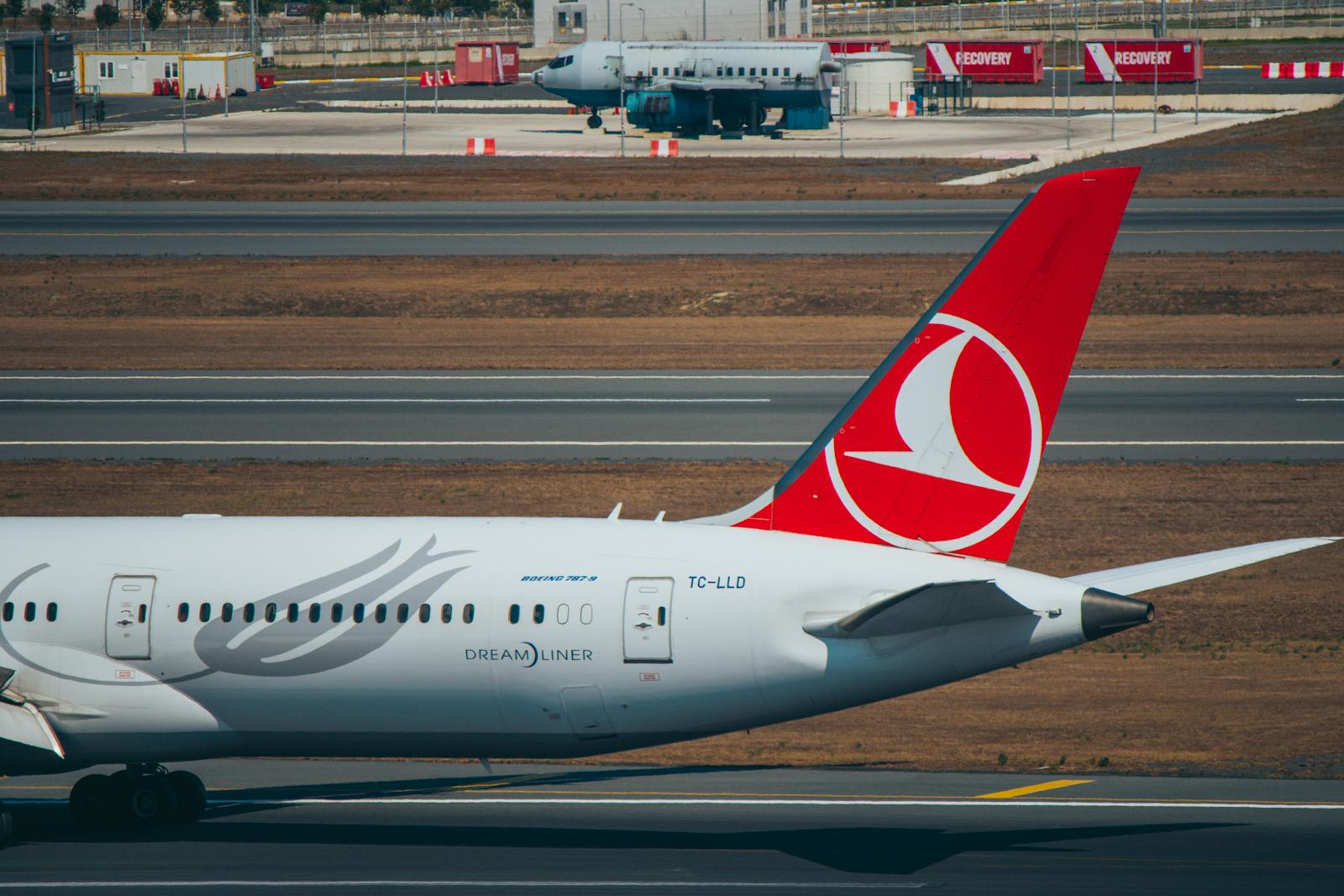
Boeing 787 economy: what actually matters
The Longhaulist team updated
Direct answer
The Boeing 787 Dreamliner improves long-haul economy in three measurable ways: cabin altitude is lower (6,000 ft vs 8,000 ft on older aircraft), cabin humidity is higher (~15–20% vs 4–10%), and the engine and airframe noise is lower than on the 777 or 747. These changes reduce arrival fatigue and dehydration symptoms.
What the 787 does not change: seat width, pitch, or how reclined-passenger geometry works. Most operators run 9-abreast (3-3-3) at 17-inch seat width, which is narrower than the original Boeing spec called for. Pick your seat carefully.
Why it matters for long-haul economy
If you’re flying 10+ hours in economy, the aircraft type accounts for a real fraction of how you feel on arrival. Most of the “why do I feel so wrecked after that flight” experience is some combination of dehydration, fatigue from low oxygen partial pressure, sleep disruption from noise, and circulatory issues from sitting. The 787 was designed specifically to fix the first three.
Whether that translates to “I felt better” depends on which 787 you flew (operator config varies), where you sat (rows matter), and what you did to manage the rest (sleep, hydration, movement).
The three things the 787 actually improves
Cabin altitude: 6,000 ft instead of 8,000 ft
Older aircraft pressurise the cabin to roughly 8,000 ft equivalent altitude. The 787’s composite fuselage allows ~6,000 ft. The difference matters: at 8,000 ft, blood oxygen saturation drops to ~93% in healthy adults, vs ~96% at 6,000 ft.
For most passengers, that 3-percentage-point difference translates to:
- Less post-flight headache
- Less of the “foggy” cognitive impairment in the second half of long flights
- Less subjective fatigue on arrival
A Boeing-funded study with researchers at Oklahoma State University tested this directly and showed measurable reductions in self-reported symptoms at the lower altitude. Not a transformation. A real, repeatable improvement.
Cabin humidity: ~15–20% instead of 4–10%
The aluminium-fuselage problem is corrosion: airlines run older cabins dry to protect the airframe. The 787’s composite fuselage doesn’t corrode, so the air system can hold more moisture.
In practical terms:
- Eyes and nasal passages stay less raw
- Skin doesn’t tighten as fast
- Contact lens wearers get a couple of extra hours before things go bad
Indoor air at sea level is typically 40–60% humidity. The 787 doesn’t reach that. But going from 5% to 18% is the difference between “desert” and “dry but tolerable”.
Noise: quieter than the 777 and 747
Engine noise on the 787’s GEnx and Trent 1000 powerplants is lower than on previous-generation widebodies. The composite airframe also dampens cabin noise. Typical cruise sound levels in mid-cabin economy are about 78–82 dB on the 787 vs 82–86 dB on the 777.
A 4 dB reduction sounds small. On a 12-hour flight, it’s the difference between “I can hear conversation around me” and “I need active noise cancellation to think”.
Headphones (active noise cancellation) still help on a 787 — they reduce engine drone and HVAC hum further. But you’ll need them less than on a 777.
What the 787 doesn’t fix
Seat width
The original 787 spec assumed 8-abreast economy at ~18.5 inches wide. Most operators chose 9-abreast at ~17 inches to fit more passengers. That makes 787 economy seats narrower than 777 economy on most operators (777 9-abreast was the standard; 787 9-abreast was a downgrade).
If you’re broad-shouldered, the 787 economy seat feels tight. The cabin improvements don’t change that.
Seat pitch
Pitch is operator choice. Most legacy long-haul carriers run 31–32 inches on the 787. Some low-cost long-haul operators (e.g. early ZIPAIR, some scoot configurations) push to 30 inches.
Check SeatGuru or AeroLOPA for the specific carrier and aircraft sub-variant before you book.
Recline geometry
Same as any economy widebody. When the row in front reclines, your laptop becomes unusable.
Lavatory ratio
787 widebodies typically have a similar passenger-to-lavatory ratio as older types. Don’t expect more bathrooms.
Best seats in 787 economy
These principles apply to any 9-abreast 787 economy cabin. Specific row numbers vary by operator. For guidance matched to your priority — sleep, legroom, quiet — use the seat picker.
For sleep
- Window seats in the rear half of economy. Less foot traffic, head support against the wall, no aisle-passenger climbs.
- Avoid the row immediately ahead of the rear galley (constant noise and light).
- Avoid bulkhead window unless you’ve confirmed it has full window access — some 787 bulkhead window seats lose access to the larger windows.
For legroom
- Bulkhead row of economy — usually called row 16, 21, or 30 depending on operator. No recline issue from the row in front. Tray table is in the armrest (less stable, and the armrests don’t raise).
- Exit row — extra pitch but cold air on the legs.
- Aisle in the rear — quick lavatory access, easy to walk for circulation.
For quiet
- Forward of the wings is generally quieter on any aircraft, including the 787. The wing-mounted engines project sound backward.
- Avoid the rearmost rows — galley noise, lavatory queue, sometimes louder cabin air noise.
Specific to 787-9 vs 787-10
- 787-9: most common variant. Standard layout.
- 787-10: longer body, slightly more rear-cabin rows. Otherwise identical in cabin systems.
- 787-8: shorter, older, less common on long-haul routes. Same cabin systems.
For more on sleep-specific seat selection see How to sleep on a long-haul flight.
787 vs A350 economy
The two modern composite widebodies. Both improve on older aircraft. They differ in feel.
| 787 | A350 | |
|---|---|---|
| Cabin altitude | 6,000 ft | 6,000 ft |
| Cabin humidity | ~15–20% | ~20–25% (typical) |
| Typical economy width (most ops) | 17 in (9-abreast) | 18 in (9-abreast) |
| Noise (mid-cabin economy) | ~78–82 dB | ~76–80 dB |
| Window size | Larger (electronic dimming) | Standard, mechanical shade |
| Overhead bin volume | Generous | Generous |
The A350 wins narrowly on width and noise. The 787 wins on the windows (the electronic dimming is genuinely useful for circadian management). Both feel substantially better than a 777 or A330 after 10+ hours.
We go deeper on the A350 in Airbus A350 economy: what actually matters.
What it actually changes on arrival
The 787’s cabin improvements don’t eliminate jet lag — that’s a circadian problem driven by light, not aircraft type. They reduce:
- The post-flight headache rate
- Dehydration symptoms (chapped lips, raw throat)
- The feeling of needing 24 hours to recover from the flight itself (separate from time zone shift)
That last one is the practical win. On a 777 from London to Sydney, most people lose a day to flight fatigue before they can even start dealing with jet lag. On a 787, that recovery is shorter — closer to half a day for most passengers.
For the time-zone shift itself, use the jet lag calculator. The aircraft doesn’t change that arithmetic.
When the 787 doesn’t help you
- Very short long-hauls (8–9 hours): cabin altitude differences matter less. You’ll feel a small improvement, not a dramatic one.
- Day flights you don’t sleep on: the noise and humidity wins still apply, but you weren’t going to sleep anyway. The dehydration reduction is still real.
- If the operator runs a high-density config (10-abreast on a 787 is not standard but exists): width gets tighter. Avoid these where possible.
FAQ
Is the 787 better than the 777 for long-haul economy? On cabin atmosphere, yes — lower altitude, more humid, quieter. On seat width and pitch, the 777 often wins (most 777s are 10-abreast economy at 17 inches, but the seats are typically built into a slightly wider fuselage). Net: the 787 feels better after 10+ hours for most passengers.
Is the 787 quieter than the A350? Slightly less quiet. Both are dramatically quieter than 777s, 747s, or A330s.
What’s the best seat in 787 economy for sleep? A window seat in the rear half, away from the rear galley. Bulkhead window with confirmed window access is also good if you don’t mind the fixed tray table.
Does the 787 prevent jet lag? No. Jet lag is driven by light exposure timing, not aircraft type. The 787 reduces flight fatigue but not circadian misalignment.
Why are 787 economy seats narrower than 777 seats? Boeing originally designed the 787 cabin for 8-abreast economy at 18.5 inches. Most operators chose 9-abreast at 17 inches to add capacity. The aircraft permits both; airlines chose density.
Are 787 windows really that different? Yes — they’re about 30% larger than standard widebody windows and use electrochromic dimming instead of shades. Useful for circadian light management on day flights.
Which airlines fly the best 787 economy? Pitch and width vary by airline. Japan Airlines, ANA, and EVA run more generous 787 economy configurations. Low-cost long-haul operators (Norse, ZIPAIR) typically run tighter ones.
Sources
- Bagshaw, M. & DeHart, R., 2018, Fundamentals of Aerospace Medicine (5th ed.): cabin altitude and oxygen saturation
- Muhm et al., 2007, New England Journal of Medicine: Effect of Aircraft-Cabin Altitude on Passenger Discomfort
- Boeing 787 program data: cabin altitude and humidity specifications
- Hocking, M.B., 2002, Indoor and Built Environment: aircraft cabin air quality