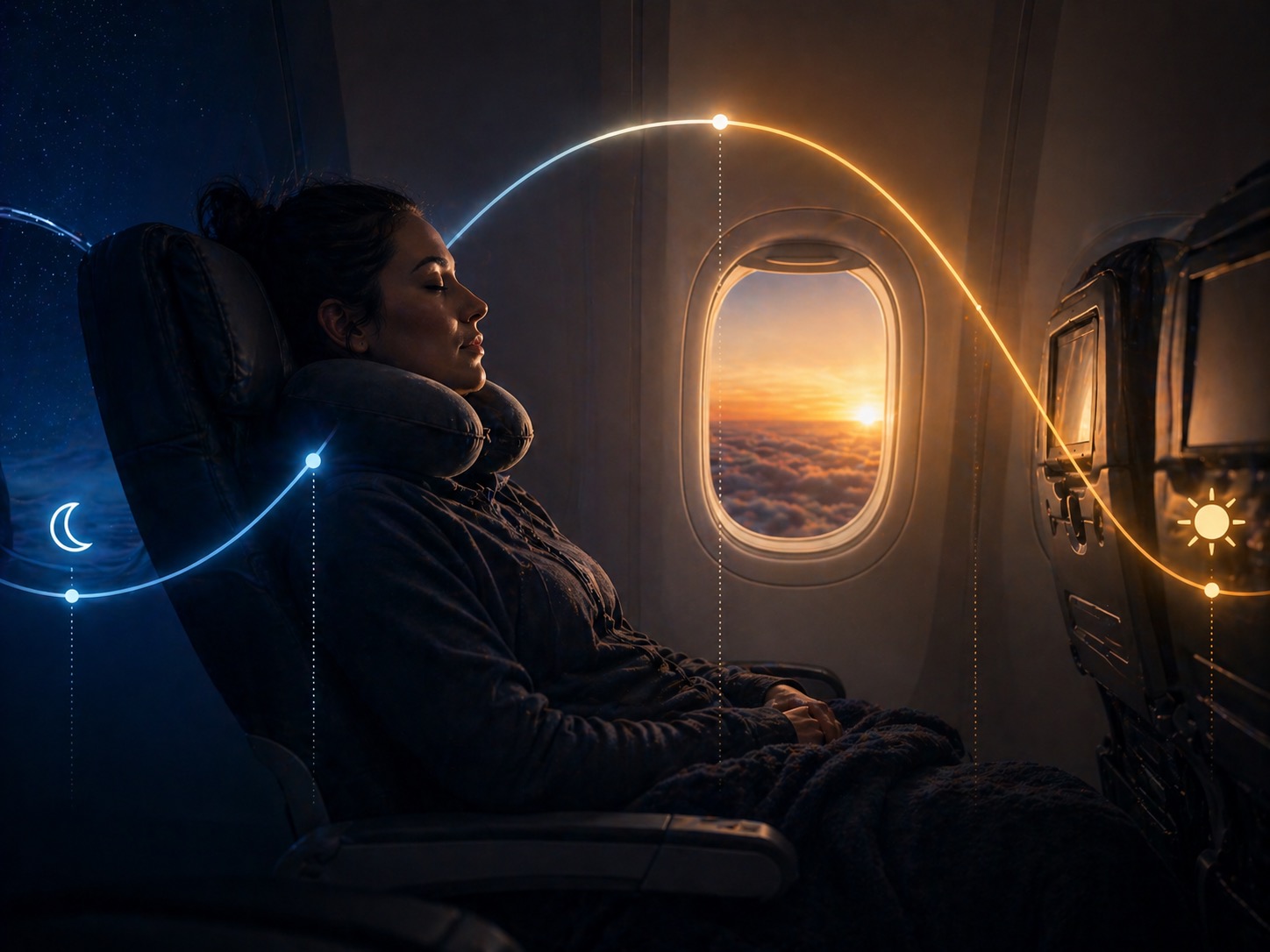
How to sleep on a long-haul flight
The Longhaulist team
Key takeaways
- Sleep timing matters as much as sleep quantity — align your in-flight sleep with destination night-time.
- Window seat is the best seat for sleeping. Choose it over the aisle. Avoid rows near galleys and lavatories.
- Eye mask + earplugs is the highest-ROI gear combination. Everything else is secondary.
- Avoid alcohol — it disrupts sleep architecture and makes jet lag adaptation slower.
- Sleeping pills sedate but don't shift your circadian clock. The adjustment still has to happen.
Sleeping on a long-haul economy flight is a problem worth solving carefully, because solving it badly — sleeping at the wrong time, with the wrong setup — can cost you a day or more of functional time at the destination.
Two distinct questions matter here. The first is mechanical: how to actually fall asleep in an upright seat in a noisy, dry, bright tube. The second is strategic: when to sleep so that your circadian clock arrives roughly in sync with local time. Getting the mechanics right but the timing wrong is only half a solution.
The cabin environment, honestly
Economy class on a long-haul flight is a specific physiological context that most sleep advice ignores. Understanding it helps you stop fighting conditions you cannot change and start managing the ones you can.
| Condition | Reality |
|---|---|
| Humidity | 10–20% (vs 30–60% at ground level). Dries out mucous membranes, contributes to dehydration. |
| Cabin altitude | Equivalent to 6,000–8,000 ft. Mild drop in blood oxygen. Some headaches and fatigue follow. |
| Noise | 75–85 dB — roughly equivalent to a busy road. Too loud for easy sleep without mitigation. |
| Temperature | 22–24°C. Cooler than most prefer, but actually conducive to sleep onset. Bring a layer. |
| Light | Window sun, overhead cabin lights, and screens everywhere. The strongest disruptor of sleep and circadian timing. |
When to sleep: the strategic question
Before deciding how to sleep, decide when. The answer depends on your direction of travel and destination time.
The goal is to sleep in alignment with destination night-time — not home night-time. If you are flying London to Tokyo (a 9-hour eastward shift) on an overnight flight departing at 21:00 London time, Tokyo time when you board is 06:00. Sleeping the full flight means arriving having slept through the local morning — not ideal for adaptation.
A better strategy:
- Stay awake for the first 2–3 hours of the flight
- Sleep during the portion that corresponds to destination night-time
- Wake before local morning
This is harder than simply sleeping whenever you feel tired, but it shortens your adaptation window materially.
For westward travel, alignment is often simpler because the flight typically pushes you toward later sleeping — which is the westward direction anyway.
Seat selection
The window seat is better for sleeping. This is not opinion — it gives you a wall to lean against, control over the window blind (and therefore light), and means nobody climbs over you during the night.
If you are in a middle or aisle seat, the aisle is preferable to the middle. You get one open side and can lean slightly without resting on a stranger.
Rows to avoid for sleep:
- Near the galley — carts, preparation noise, crew conversations, and light from the galley curtain
- Near the lavatory — foot traffic throughout the night, periodic door noise, light when the door opens
- Bulkhead rows — no seat in front to put your feet under; often tighter than they look; sometimes bassinet positions
- Exit rows — seats often do not recline, or recline less, due to safety requirements
- Last rows of a section — galleys directly behind, and the seats may not fully recline
Check the seat map for your specific aircraft before selecting. SeatGuru has maps for most routes and highlights problem rows.
Gear that makes a difference
Eye mask
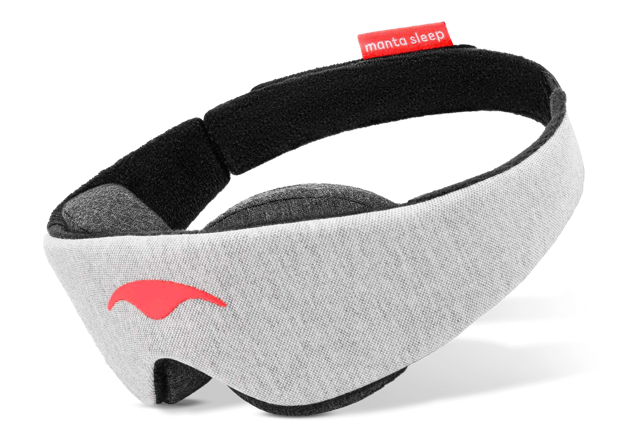
The highest-return item you can carry. A good eye mask blocks light completely, fits without pressing on your eyelids (lid pressure disrupts REM sleep), and stays in place when you turn your head.
Contoured masks — shaped to sit away from the eye — are better than flat fabric masks. They allow REM eye movement without resistance, are more comfortable over longer periods, and don’t disturb eyelashes.
Manta
Manta Sleep Mask
Contoured cups sit away from eyes — no lid pressure, no interference with REM movement. Adjustable for most face shapes. Full blackout. Stays in place when you turn.
View on AmazonNeck pillow
The standard horseshoe pillow sold at every airport is optimised for display, not sleep. It positions your head in the air when your neck wants support and provides nothing when you lean to one side. The failure mode is that your cervical muscles stay active to prevent your head from falling, resulting in neck pain rather than sleep.
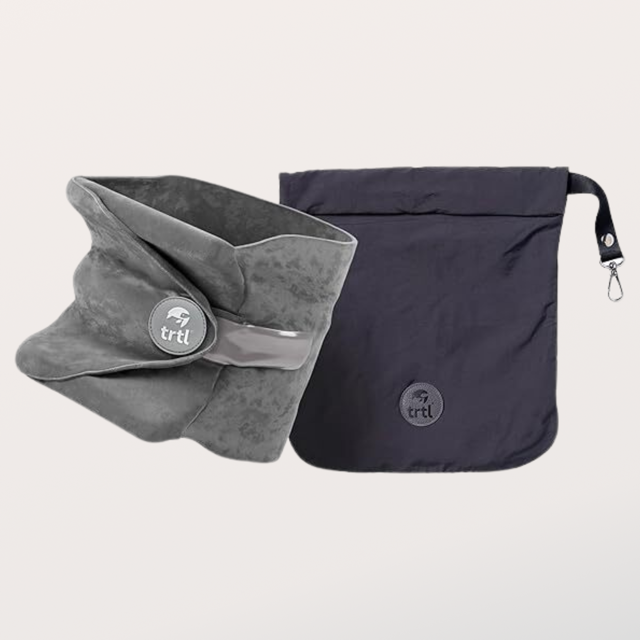
Two designs that actually work:
Trtl
Trtl Travel Pillow
Internal support spine holds the neck in a neutral position without the bulk of a horseshoe. Works for side-sleeping against a window. Machine washable, highly packable.
View on Amazon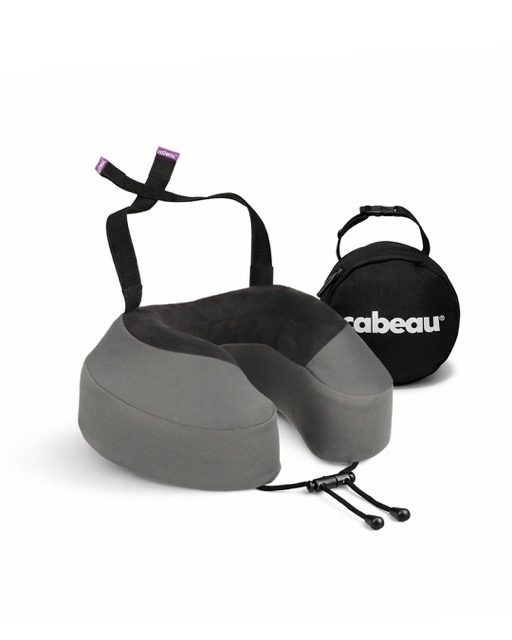
Cabeau
Cabeau Evolution S3 Travel Pillow
Rear strap clips to the seat headrest to prevent forward head drop. Memory foam. 360° support. Compresses into carry pouch. Works in all seat types.
View on AmazonThe Trtl uses an internal spine for lateral support and is highly packable. The Cabeau Evolution’s rear strap clips to the seat headrest to prevent forward head drop — useful if you tend to fall asleep sitting more upright.
Noise reduction
Standard foam earplugs (29–33 dB NRR) are cheap and highly effective at reducing the background engine roar. Carry several pairs — one set for sleeping, others as backups.
Active noise-cancelling headphones reduce the continuous low-frequency engine noise significantly and let you play white noise or sleep-focused audio. They don’t block sound as completely as earplugs, but the combination of noise cancellation and controlled audio works well for many people.
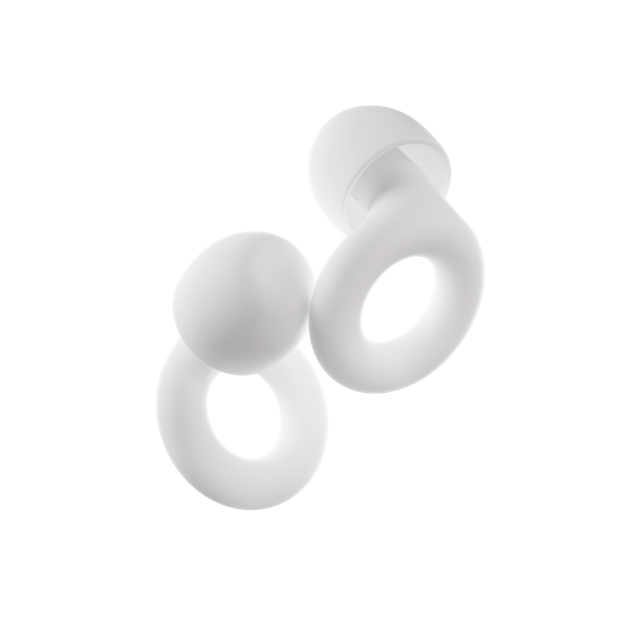
Loop
Loop Quiet 2 Earplugs
24 dB SNR in reusable silicone — more comfortable for long-duration wear than foam for many people. Four ear-tip sizes included. Good for those who find foam earplugs irritating.
View on Amazon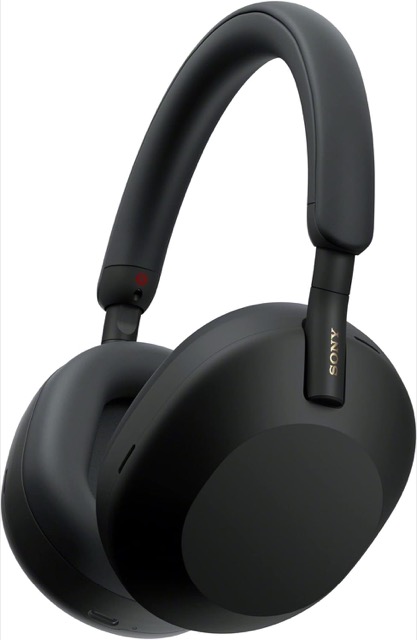
Sony
Sony WH-1000XM5 Wireless Headphones
Best-in-class ANC for continuous low-frequency noise (engines, aircon). Comfortable over-ear fit for multi-hour wear. 30-hour battery. Folds flat for carry-on.
View on AmazonFor sleeping without audio: foam earplugs are more effective per gram. For controlling your audio environment: noise-cancelling headphones earn their weight.
Clothing
Wear what you would wear to sleep in, within the limits of what you are comfortable wearing in public. Tight waistbands, rigid trousers, synthetic fabrics, and constrictive footwear all become significantly less tolerable by hour six.
Compression socks for the circulatory reasons covered in the compression socks guide. Loose layers you can add or remove. Slip-on shoes.
What to avoid
Alcohol. A glass of wine at cruising altitude hits harder than at ground level. Alcohol disrupts sleep architecture: it shortens the time to sleep onset but reduces sleep quality, suppresses REM sleep, and causes more waking in the second half of the sleep period. Avoid it during the windows when you are trying to sleep strategically.
Heavy meals immediately before sleeping. The body suppresses digestion during sleep. A large meal shortly before your intended sleep window delays sleep onset and reduces sleep quality. Eat lightly in the hours before your planned in-flight sleep.
Screens before sleep. Short-wavelength screen light suppresses melatonin and signals wakefulness to the clock. If you are trying to sleep toward the destination-aligned window, avoid screens for 30–40 minutes before your intended sleep onset. Switch to audio only, or use blue-light blocking glasses.
Melatonin on the plane
Low-dose melatonin (0.3–0.5 mg) taken 30 minutes before your destination-aligned bedtime is the one pharmacological intervention with good evidence for long-haul flights — for eastward travel.
On an eastward flight where your destination bedtime falls during the flight, take it then — not at your home-time bedtime. The jet lag calculator generates melatonin timing for each day of the adaptation schedule, including the flight day.
A practical setup for overnight eastward flights
- Before you leave for the airport — compression socks on, eye mask and earplugs in a jacket pocket (not in the overhead locker)
- On boarding — note the local time at destination; plan your sleep window accordingly
- First hours — stay awake; eat the first meal service if you want it
- Before your target sleep window — dim your screen, then turn it off; insert earplugs; close the window blind; put on the eye mask; take 0.5 mg melatonin if flying eastward; recline 4–6 inches
- Sleep — the goal is not 8 hours; 4–5 hours in the destination-aligned window is a meaningful win
- On arrival — seek light at the appropriate time; the jet lag calculator gives you the specific windows
For the circadian science behind light timing and melatonin, see jet lag: what actually works. For DVT prevention, see what compression socks actually do on long-haul flights.