What compression socks actually do on long-haul flights
The Longhaulist team
Key takeaways
- DVT risk increases on flights over 8 hours due to immobility, reduced cabin pressure, and dehydration.
- Graduated compression socks (pressure higher at ankle, lower toward knee) improve venous blood return.
- 15–20 mmHg for most healthy travellers. 20–30 mmHg if you have history of significant swelling.
- Knee-high is sufficient. Thigh-high is not needed for typical travel use.
- Put them on before you leave for the airport — not after your legs have already started to swell.
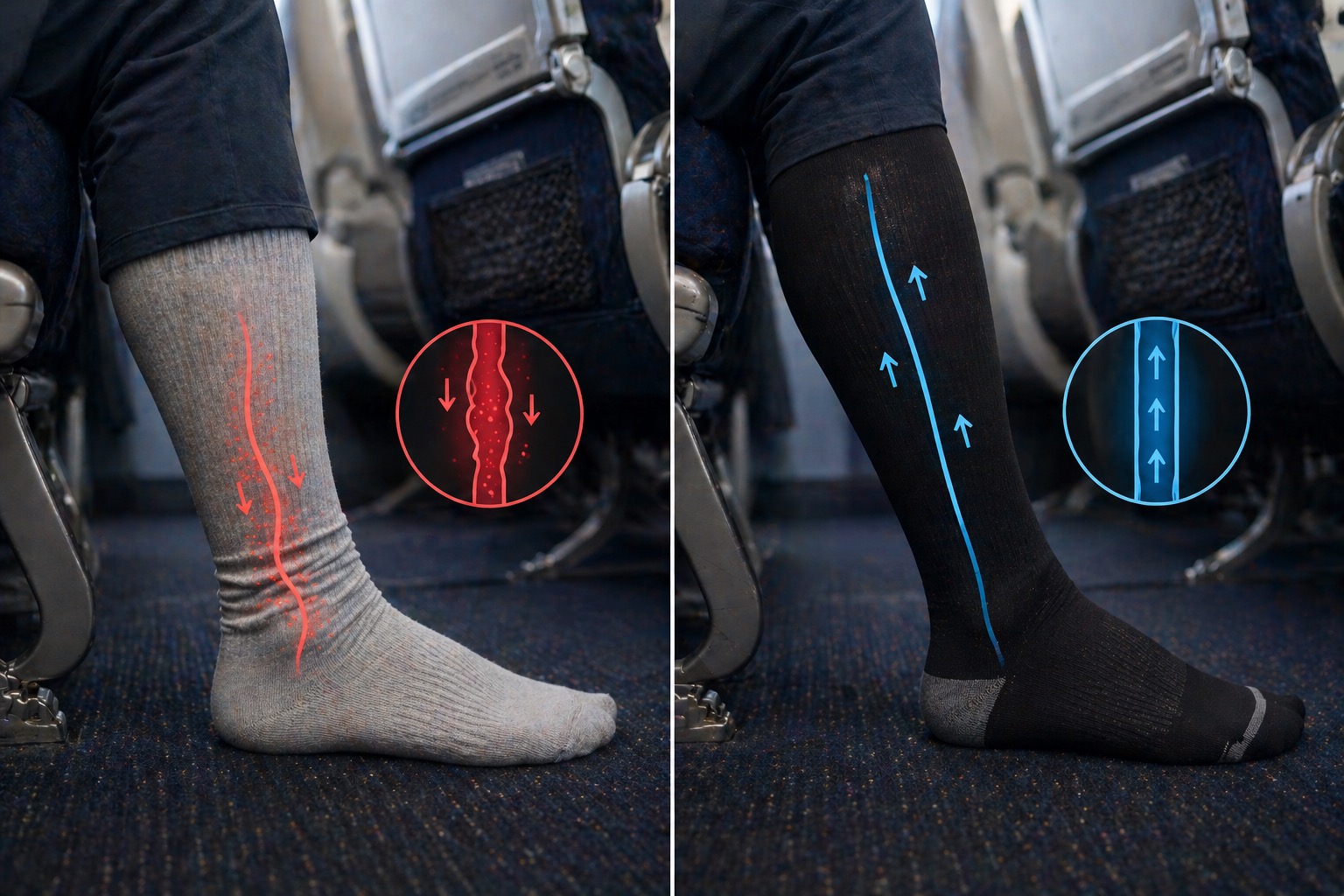
The case for compression socks on long-haul flights is not complicated: sitting immobile for 10 hours in a pressurised tube at altitude slows venous blood return from your legs, increases the risk of clots, and reliably produces swollen ankles. Graduated compression socks address all three, and the evidence for them is solid enough that most aviation medicine bodies recommend them for flights over 8 hours.
This is not a gear recommendation dressed up as health advice. It is health advice that happens to require gear.
Why long-haul flight is bad for your legs
Deep vein thrombosis (DVT) is the formation of a blood clot in a deep vein — most commonly in the calf or thigh. On long-haul flights, three conditions combine to raise the risk:
Immobility. The calf muscles act as a secondary pump for the venous system, pushing blood back toward the heart with each step. Sitting still for hours eliminates this. Blood pools in the lower leg veins.
Reduced cabin pressure. Commercial aircraft cabins are pressurised to an equivalent altitude of roughly 6,000–8,000 feet. At this pressure, blood oxygen saturation drops slightly and blood viscosity changes, making clotting somewhat more likely.
Dehydration. The cabin air is extremely dry — typically 10–20% relative humidity, compared to 30–60% at sea level. Dehydration increases blood thickness.
~1 in 4,500
long-haul flights result in a symptomatic DVT for healthy travellers
The overall absolute risk for healthy travellers is low. But the risk increases substantially with flight duration — above 8 hours the risk roughly doubles per additional 2 hours — and the consequences of a clot that travels to the lungs (pulmonary embolism) are serious.
How compression socks work
Graduated compression applies more pressure at the ankle and progressively less toward the knee. Measured in millimetres of mercury (mmHg), the pressure gradient squeezes the vein walls inward, which narrows the vessel diameter, increases blood flow velocity, and reduces pooling.
The gradient is the key word. Non-graduated compression — flat compression with uniform pressure — does not create this flow effect and can actually impede circulation if too tight. Any sock you buy for DVT prevention should specify graduated compression.
What pressure rating to look for
For travel use, the relevant pressure range is 15–30 mmHg:
| Pressure | Who it’s for |
|---|---|
| 15–20 mmHg | Most healthy travellers, mild swelling, first-time compression sock users |
| 20–30 mmHg | History of pronounced in-flight swelling, varicose veins, prolonged standing before/after flight |
| 30–40 mmHg+ | Medical-grade, by prescription only — not for self-selection |
For most healthy long-haul passengers, 15–20 mmHg is sufficient. If you have previously had significant in-flight leg swelling, 20–30 mmHg is worth considering.
Knee-high vs thigh-high
For DVT prevention on flights, knee-high socks are sufficient. DVT most commonly forms in the calf veins, and knee-high compression addresses this.
Thigh-high compression garments are used for specific medical conditions affecting the upper leg. They are unnecessary for typical travel use and considerably harder to put on in an airplane lavatory.
Putting them on correctly
This matters more than people expect. A compression sock applied with wrinkles or bunching creates areas of high localised pressure that can actually restrict circulation — the opposite of the intention.
- Put them on before you board — ideally before you leave for the airport, while your legs are not yet swollen
- Smooth from the toe up, with no folds or wrinkles along the ankle or calf
- The heel should sit in the heel pocket
- If they feel painful, the sizing is wrong — uncomfortable is normal for the first 30–60 minutes, painful is not
Sizing properly
Compression socks sized only by shoe size (S/M/L/XL) may not provide the correct gradient for your calf circumference, which is the actual variable that matters.
Measure the widest part of your calf and the circumference just above the ankle before ordering, and check these against the brand’s sizing chart. Brands that include calf measurements in their sizing are more reliable than those that don’t.
Compression socks to consider
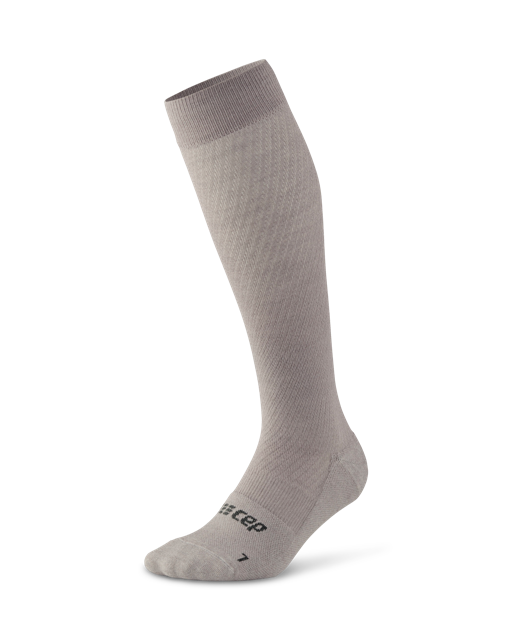
CEP
CEP Flight Compression Socks (20–30 mmHg)
Graduated 20–30 mmHg designed specifically for air travel. Size chart uses calf circumference, not just shoe size. Lightweight, no-slip fit.
View on Amazon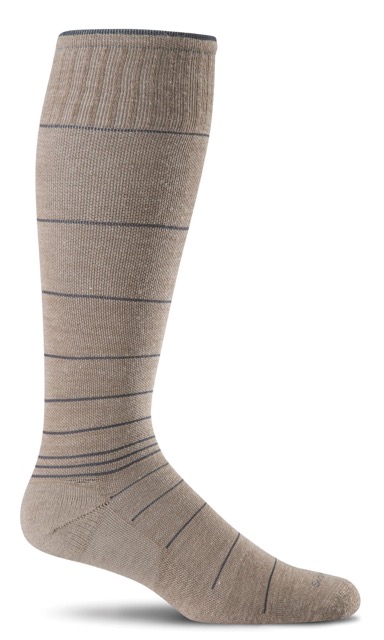
Sockwell
Sockwell Circulator Moderate Graduated Compression Socks
15–20 mmHg in merino-nylon blend. Good starting point for first-time compression sock wearers — lighter gradient, comfortable all day.
View on AmazonMovement and hydration still matter
Compression socks are not a substitute for moving your legs:
- Stand up every 60–90 minutes if you can
- Ankle circles and calf raises in your seat between movements
- Drink water throughout the flight — the dry cabin air dehydrates faster than most people notice
These complement compression. They do not replace it.
Who should not wear compression socks
Graduated compression socks are contraindicated for some conditions:
- Peripheral artery disease (PAD) — compression can further reduce already-compromised arterial blood flow
- Peripheral neuropathy — reduced sensation means you may not notice pressure that is too high
- Certain skin conditions — open wounds, severe dermatitis, or active infections on the lower leg
- Acute DVT — management of an active clot requires specific medical guidance, not self-applied compression
If you have any circulatory condition, diabetes with vascular involvement, or have been told by a doctor that compression garments are not appropriate for you, follow that guidance.
For timing your sleep and circadian adaptation on the flight itself, see how to sleep on a long-haul flight and the jet lag calculator.