Best sleeping positions for long-haul economy flights
The Longhaulist team updated
Key takeaways
- Three positions actually work: window-supported side sleep, chin-stable upright sleep, and short-duration forward lean.
- The constraint is stability, not comfort — your head needs to stay supported without muscle effort.
- Window seats are strictly better for sleep because the cabin wall provides passive head support.
- Chin drop is the primary failure mode in upright sleep. The right neck pillow solves this.
- Realistic sleep blocks in economy: 90 minutes to 3 hours per block, not continuous 8-hour sleep.
Sleeping in long-haul economy comes down to three positions that actually hold: window-supported side sleep, chin-stable upright sleep, and short-duration forward lean. Everything else fails within 60–120 minutes.
The constraint is not comfort — it is stability. Your head, spine, and legs need to stay supported without constant muscle engagement. If one part collapses (usually the neck), you wake up. The correct position depends on your seat (window vs aisle), your ability to control head movement, and how long you need to stay asleep.
Why this matters for long-haul economy
On an 8–14 hour flight, poor sleep posture compounds fatigue, neck pain, and lower-body stiffness. You are not trying to sleep “comfortably.” You are trying to maintain a position that your body can hold passively for hours.
Economy seats restrict movement, reduce leg elevation, and force upright sleep. Without a stable setup, sleep becomes fragmented into short cycles that do not restore alertness.
The three positions that actually work
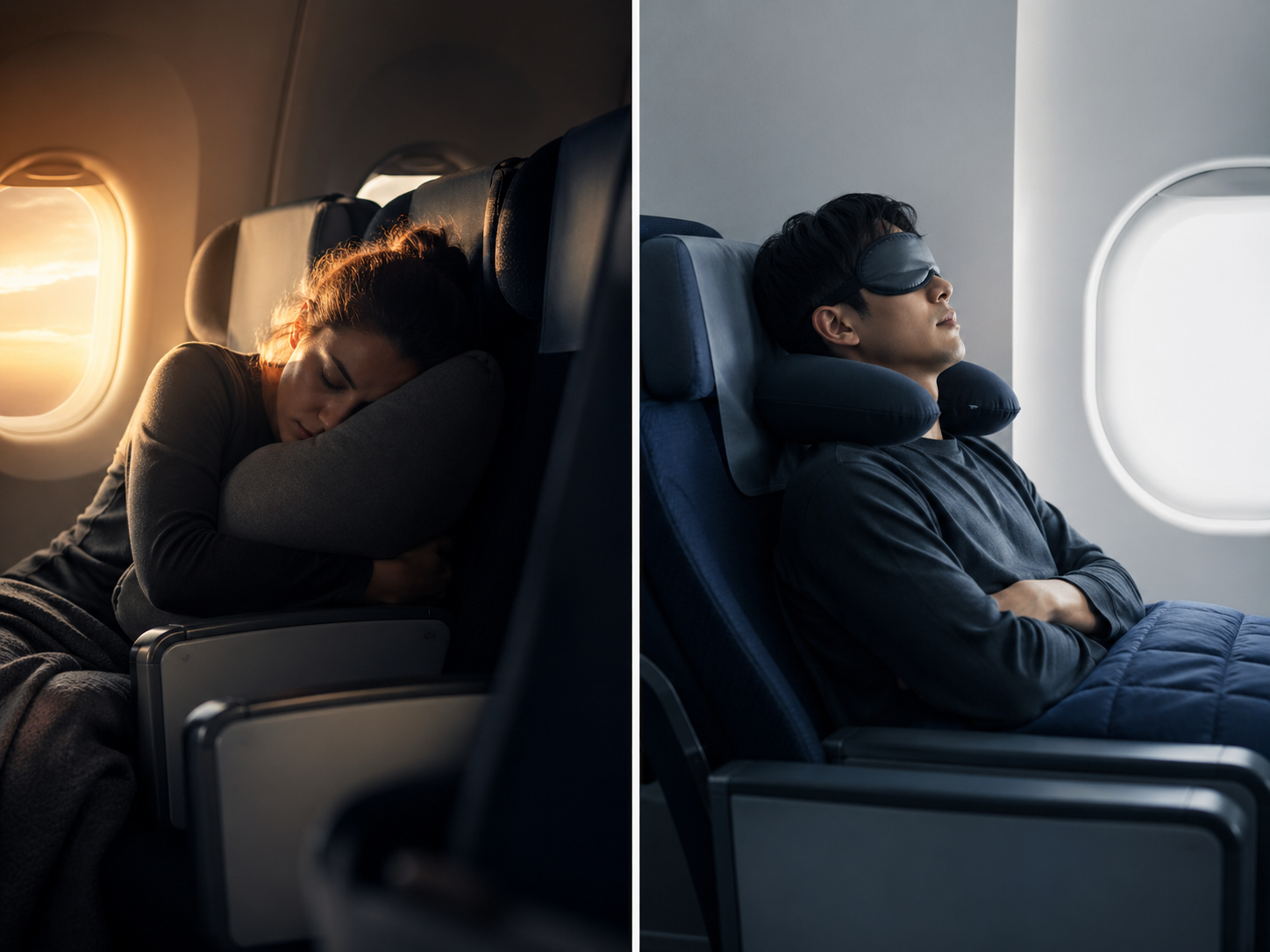
1. Window-supported side sleep
This is the most stable position available in economy — but only if you have a window seat. The seat picker shows which windows to target on your aircraft.
You lean your head and upper body against the cabin wall, using it as a fixed support point. This removes the need for neck muscles to hold your head in place. The spine is slightly curved but passive.
Why it works
- External support prevents head drop
- Minimal muscle engagement once settled
- Can sustain multi-hour sleep cycles
Failure points
- Poor alignment if the window edge is too low or too far back
- Shoulder compression over time
- No adjustability without waking
Duration tolerance: 2–5 hours if properly supported.
2. Supported upright sleep (chin-stable)
This is the most reliable position across all seat types.
You sit upright with slight recline and prevent your head from falling forward. The critical variable is chin control — if your chin drops, you wake up.
Why it works
- Spine remains aligned with the seat
- Compatible with aisle and middle seats
- Less pressure on one side of the body
Failure points
- Chin drop leading to repeated wake-ups
- Neck strain without proper support
- Requires micro-adjustments if unstable
Duration tolerance: 90 minutes to 3 hours depending on support quality.
The solution to chin drop is a neck pillow that holds from the front, not a horseshoe that only supports from behind. Two designs that actually work:
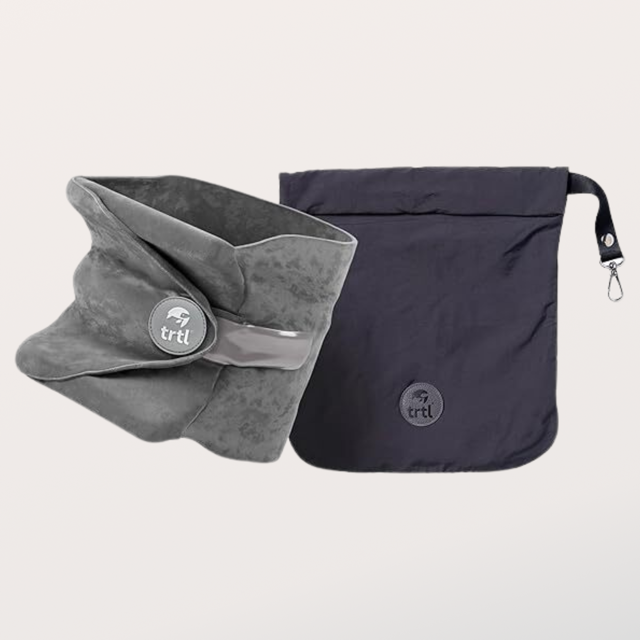
Trtl
Trtl Travel Pillow
Internal support spine holds the neck in a neutral position without the bulk of a horseshoe. Works for side-sleeping against a window. Machine washable, highly packable.
View on Amazon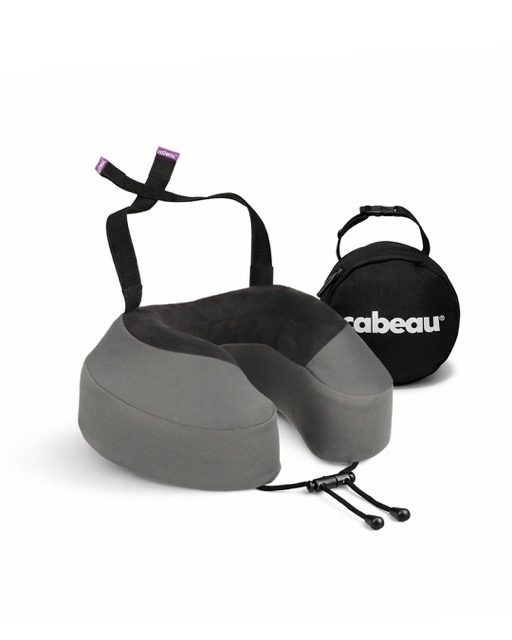
Cabeau
Cabeau Evolution S3 Travel Pillow
Rear strap clips to the seat headrest to prevent forward head drop. Memory foam. 360° support. Compresses into carry pouch. Works in all seat types.
View on Amazon3. Forward lean (tray table)
This is a temporary position, not a full-flight solution.
You lean forward onto the tray table, often using a pillow or folded arms. It reduces neck strain initially but shifts load to the lower back and hips.
Why it works
- Eliminates backward instability
- Reduces neck extension strain initially
Failure points
- Lumbar compression builds quickly
- Circulation in legs is restricted
- Becomes uncomfortable within 30–90 minutes
Duration tolerance: 30–90 minutes.
Why most people fail to sleep in economy
The failure is mechanical, not behavioral.
Chin drop. Your head falls forward during muscle relaxation. This triggers micro-arousals and prevents deep sleep. It is the most common and most fixable failure.
Lumbar collapse. Without support, the lower back rounds. This creates tension that wakes you up — often before you realise you were ever asleep.
Leg compression. Feet flat on the floor with no elevation leads to stiffness and discomfort, especially after 2+ hours.
Instability. If your body requires constant micro-adjustment, you never enter sustained sleep.
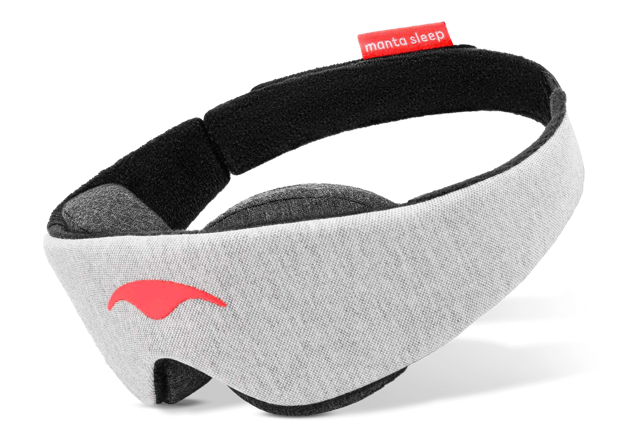
Manta
Manta Sleep Mask
Contoured cups sit away from eyes — no lid pressure, no interference with REM movement. Adjustable for most face shapes. Full blackout. Stays in place when you turn.
View on AmazonMatching position to your seat
| Seat | Best position | Notes |
|---|---|---|
| Window | Side sleep against wall | Best option on any flight where sleep matters |
| Aisle | Upright with chin support | Allows movement; no lateral support |
| Middle | Upright only | Worst for sleep; both neighbours restrict movement |
Aircraft type matters less than seat position. A newer aircraft like the A350 or 787 has better cabin pressure and humidity, which improves your baseline — but the seat geometry still dictates what posture is possible.
A 10-hour overnight flight setup
Scenario: aisle seat, 10-hour overnight flight.
- Boarding — compression socks on, neck pillow and eye mask in jacket pocket
- Meal service — eat lightly; avoid alcohol
- Before sleep window — recline seat, insert earplugs, put on eye mask, deploy neck pillow
- First sleep block — target 90 minutes upright, chin supported
- Brief wake — adjust posture, reposition neck pillow
- Second sleep block — 60–90 minutes; forward lean is acceptable if upright becomes uncomfortable
- Arrival window — remove eye mask; seek light or avoid it depending on your jet lag plan
FAQ
What is the best position to sleep on a plane in economy? Window-supported side sleep is the most stable. If unavailable, upright sleep with chin support is the most reliable alternative.
Is it better to lean forward or backward on a plane? Backward (upright with recline) is more sustainable. Forward lean works only for short periods.
Can you sleep on a plane without a neck pillow? Yes, but only if you have external support (window seat). Without a window, neck instability limits most people to short blocks.
Why does my neck hurt after sleeping on a plane? Your head was unsupported during sleep, causing neck muscles to work continuously — leading to strain and repeated micro-adjustments.
How do you sleep sitting upright without pain? Stabilise your head, maintain slight recline, and reduce lower back rounding. A chin-stabilising neck pillow handles most of this.
Which seat is best for sleeping on long-haul flights? Window seats. They provide a fixed surface for head support and let you control the window blind.
How long can you realistically sleep in economy? In one block, typically 60–120 minutes. With optimal setup (window seat, neck pillow, eye mask, earplugs), some people reach 3–4 hours per block.
Do tray table pillows actually work? Only short-term. They shift strain to the lower back and restrict leg circulation. Use for 30–60 minutes at most.
For the full in-flight sleep setup — timing, gear, and what to avoid — see how to sleep on a long-haul flight. For destination adaptation after you land, use the jet lag calculator.